
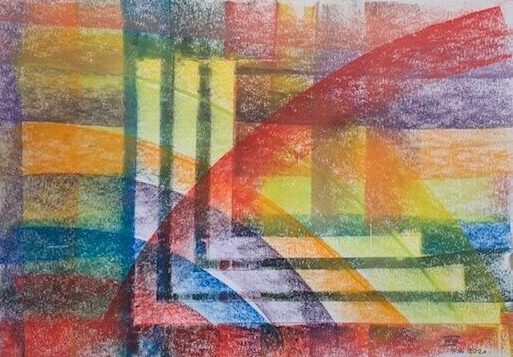

MFHK. Behind these four letters is hiding an artist who has found his expression in his lines, in his colours, surfaces, shapes and also in a plastic three-dimensionality. The painter and sculptor MFHK works as well in the Dutch Caribbean as in his second adpted home Nova Scotia (Canada), and now in Europe too. His Eurpean origin leads to the deliberate mix of figures and colours from these three regions. Each of which has shaped the artist. His `Caribbean Way of Life´ has an undeniable influence in special on his current plastics/sculptures and underlines the plasticity of the figures.
The cheerful, optimistic mood emanating from the coordinated variety of colours whith their lively contrasts reflects the lightness of the Caribbean sculptures takes the viewer into a world of colour and form. These works simply do not allow any sadness. The materials used arrange this art in the direction of the `Arte Povera´, but add a new facet to it through their colours.
This colour palette is new within this art movement. It takes to an independent position within this sector. The use of natural materials or the inclusion of waste products from industrial production, which the artist has recycled for his own art, plays a decisive role as a third statement alongside colour and shapes. A statement is made here that also shows a line for today and tomorrow.
However the artist attaches importance to the fact that this direction has nothing to do with any kind of a political ideology, but re-evaluates the `Arte Povera´ sector in our time. MFHK also documents the desire for colour in his visual work. The surface is reproduced in colour, light and often with lines and traces. Here he is influenced by both the colours of the Caribbean and the colours of his surroundings on Nova Scotia.
The lines in many of his works give the pictures a certain depth and thus often leave a spatial impression. Geometric shapes can also be found here. This expressive, painterly style of expression by the artist puts him close to the wrongfully so called `Abstract Expressionism´. If you look at his pictures of the northern lights, for example, you can also see his European roots. In general, it can be said that his work reflects impression of his current surroundings as well as the colours from his many travels in northern, central and southern Europe as well as colour impressions from North Africa, South-East Asia, New Zeeland and North America.
The later can be seen above all in his paintings on pressed cardboard and canvas. The peculiarity of his oevre lies in the variety of colour materials used such as chalk, pencil, coloured pencil, wax, oil, acrylic, as well as in the variability of his surfaces such as paper, pressed cardboard, wood and canvas. But you always know which artist it is. Psaligraphies glued to certain substrates also testify to the willingness to experiment of this artist and are another facet in his work. Another peculiarity lies in his radical refusal to reproduce even just one of his works. This gives them a distinct exclusivity.
In his youth MFHK painted, sculpted and had some successful exhibitions in northern Germany. Colors, shapes and forms have been his passion from young age. In spite of these experience and his innate passion for the arts, he ended up becoming a dentist, more specially, a stomatologist.
Within this field of work, he was well known throughout Germany especially in the discipline of `Compatible Dentistry´. He was a co-founder of the German society of „Environmental Dentistry“ (DEGUZ), and member of various scientific advisory boards.